|
Whey protein has high anti-inflammatory potential
and has been utilized to help reduce the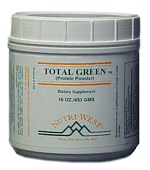 inflammation in critically ill trauma patients receiving enteral
nutritional support; C-reactive protein concentrations (marker of
inflammation) and total inflammatory index dramatically fell in one
study (Vehe KL et al. The prognostic inflammatory and nutritional
index in traumatized patients receiving enteral nutrition support. J
Am Coll Nutr. 1991 Aug;10(4):355-63).
inflammation in critically ill trauma patients receiving enteral
nutritional support; C-reactive protein concentrations (marker of
inflammation) and total inflammatory index dramatically fell in one
study (Vehe KL et al. The prognostic inflammatory and nutritional
index in traumatized patients receiving enteral nutrition support. J
Am Coll Nutr. 1991 Aug;10(4):355-63). Whey has a high
glycomacropeptide content (GMP). In describing GMP, the
Journal of Nutrition reports that the "magnitude of the
anti-inflammatory effect was comparable to that of sulfasalazine,
an established drug used in the treatment of Inflammatory Bowel
disease", and that GMP promotes the growth of bifidobacteria
while inhibiting the proliferation of pathogens and binding to
lectins, all of which can increase inflammation (J Nutr
2005;135:1164-1170).
 Lactobacillus
acidophilus and Lactobacillus bulgaricus are examples of
probiotics, or good gut flora. Probiotics have recently made
headlines for their anti-inflammatory potential. In fact, it has
been proposed that dysbiosis is a prerequisite to inflammation of
the bowel (Tamboli CP, et el. Dysbiosis as a prerequisite for IBD.
Gut. 2004 Jul;53(7):1057). Recently, researchers found that
probiotic supplementation significantly reduced inflammation in the
colon by the regulation of an immune response (DiGiacinto C. et
al. Probiotic administration during remission of inflammatory bowel
disease reduces the severity of recurrent colitis by inducing an
immunoregulatory response. 2005;174:3237-46). Lactobacillus
acidophilus and Lactobacillus bulgaricus are examples of
probiotics, or good gut flora. Probiotics have recently made
headlines for their anti-inflammatory potential. In fact, it has
been proposed that dysbiosis is a prerequisite to inflammation of
the bowel (Tamboli CP, et el. Dysbiosis as a prerequisite for IBD.
Gut. 2004 Jul;53(7):1057). Recently, researchers found that
probiotic supplementation significantly reduced inflammation in the
colon by the regulation of an immune response (DiGiacinto C. et
al. Probiotic administration during remission of inflammatory bowel
disease reduces the severity of recurrent colitis by inducing an
immunoregulatory response. 2005;174:3237-46).
*Probiotics should be taken away from meals, or
enteric-coated if taken with food to optimize colonization in the
large intestine.
Antioxidants can reduce the age-related increase in
pro-inflammatory cytokines (Gemma C. Diets enriched in foods with
high antioxidant activity reverse age-induced decreases in
cerebellar beta-adrenergic function and increases in proinflammatory
cytokines. J Neurosci. 2002 Jul 15;22(14):6114-20.) They also reduce
pro-inflammatory free radicals, especially the superoxide radical.
Bioflavonoids, found in many plant sources, are anti-inflammatory
and possess high antioxidant activity. Papaya and rose hips,
both rich in phytochemicals, are two of the few plant substances
containing high amounts of the potent antioxidant lycopene (Mourvaki
E, et al. 2005).
Anti-inflammatory, natural cox-2 inhibitors: Cyclooxygenase-2
(COX-2) is the enzyme that causes inflammatory substances to be
produced in the body and is also the enzyme targeted by the cox-2
inhibitor drugs (some of these drugs were pulled from the market).
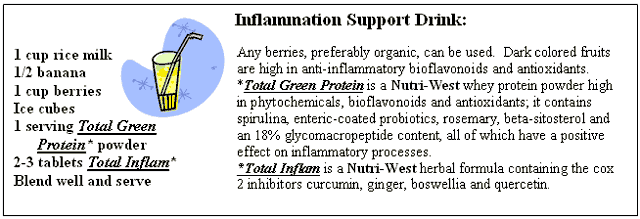
The following nutrients inhibit cox-2 naturally:
Rosemary decreases inflammation and liver cell injury (Sotelo-Felix
JI, et al. J Ethnopharmacol. 2002 Jul;81(2):145-54.) Carnasol, a
component of rosemary, is a potent inhibitor of cox 2 (Subbaramaiah
K, Cole PA, Dannenberg AJ. Retinoids and carnosol suppress
cyclooxygenase-2 transcription…Cancer Res. 2002 May 1;62(9):2522-30)
and together with rosmanol, and epirosmanol (also components of the
rosemary herb), demonstrate high antioxidant activity, which is also
anti-inflammatory.
Beta Sitosterol is a plant sterol possessing
anti-inflammatory properties (Bouic PJ et al. Monograph. Plant
sterols and sterolins. Altern Med Rev. 2001 Apr;6(2):203-6).
Beta-sitosterol decreases the inflammatory PGE2 prostaglandin by
altering the cox-2 enzyme (Awad AB et al. Prostaglandins Leukot
Essent Fatty Acids. 2004 Jun;70:511-20).
Spirulina is a particularly rich source of proteins,
vitamins, amino acids, minerals, and other nutrients that has been
proven to be, "effective to treat certain allergies,
immunodeficiency, and inflammatory processes", among other
things (Chamorro G. et al. 2002 Sep;52(3):232-40.) Some researchers
have proposed using spirulina for allergic rhinitis because it
lowers histamine and total IgE (Chen LL et al. Experimental study of
spirulina platensis in treating allergic rhinitis in rats. Zhong Nan
Da Xue Xue Bao Yi Xue Ban. 2005 Feb;30(1):96-8). C-Phycocyanin
(C-PC) is one of the major biliproteins of Spirulina, with
antioxidant and radical scavenging properties. It exhibits
anti-inflammatory properties by selectively inhibiting COX-2
(Reddy MC Biochem Biophys Res Commun. 2003 May 2;304(2):385-92) and
the inflammatory PGE2 (Romay et al. Arzneimittel-forschung. 2000
Dec;50(12):1106-9), and has been reported to have an "anti-arthritic
effect" (Remirez D et al. Inhibitory effects of Spirulina in
zymosan-induced arthritis in mice. Mediators Inflamm. 2002
Apr;11(2):75-9.)
Curcumin is a natural substance that decreases Cox-2
(Carcinogenesis. 2004 Apr 8), as well as ginger. In fact,
researchers suggest that ginger, "offers a complementary and
alternative approach to modulate the inflammatory process
involved in arthritis" (In Vitro Cell Dev Biol Anim. 2004
Mar-Apr;40(3-4):95-101). Boswellia appears to have an
influence on the eicosanoid pathway and Cox 2 as well (Integr Cancer
Ther. 2002 Mar;1(1):7-37). Another natural ingredient, quercetin,
has also been "found to effectively suppress the COX-2 promoter
activity" (Carcinogenesis, Vol. 21, No. 5, 959-963, May 2000).
To your health!
JW Brimhall, DC and the Wellness Team
|
